What Is Art Balance Elifent Example Black and White
The Goldilocks Principle got its name from a children's story in which the protagonist noticed that qualities lying midway between two opposite extremes (e.g., hot and cold, hard and soft) are pleasant, satisfying, and "but right." Wikipedia describes applications of this versatile principle in developmental psychology, economics, communication science, medicine, and astrobiology. This web log will apply the Goldilocks Principle to personal evolution, relationships, and politics.
In ancient times, several philosophers and religious leaders, living in separate cultures and with no knowledge of each other, adult the idea that optimal human functioning usually consists of a moderate balance between opposite extremes (Shapiro, 2015a). In ancient Greece, Aristotle coined the term Gilt Hateful to summarize this idea; in India, Buddha used the term Middle Way; and in People's republic of china, Confucius espoused his Doctrine of the Mean. These are dissimilar words for the same idea: Skillful, constructive functioning is more often than not moderate and balanced, and maladaptive beliefs typically involves extremes, including contrary extremes. Goldilocks would take gotten along well with both ancient philosophers and mod scientists.
Moderation versus Polarization
The concept of adaptive moderation has been prominent in the psychotherapy field for some time. This concept is particularly relevant to people whose difficulties are due to black-and-white thinking, because this type of cognition is incompatible with moderation. Black-and-white or dichotomous thinking is a hallmark of Deadline Personality Disorder, and it also appears in a wide range of other disturbances. This type of thinking is featured prominently in well-known lists of cognitive distortions by Beck (2011) and Burns (1999).
The departure between people with diagnosable disturbances and those with ordinary issues in living is more often than not just a matter of degree, and the aforementioned is true for black-and-white thinking. Anybody does information technology sometimes, and some do information technology and so much, or in regard to such important issues, that a serious disturbance results. Dichotomous thinking is frequently involved in pregnant problems in living and conflicts in relationships. Besides, blackness-and-white thinking seems to contribute mightily to the acrimonious, divisive nature of politics in the U.s.a. (and other countries) at the present fourth dimension.
Dichotomous thinking is typically polarized—complex realities are simplified into two opposite extremes or poles of a spectrum. For instance, an individual might categorize all possible responses to conflict as either submissive or ambitious because she is unaware of assertive beliefs as a distinct choice that lies in betwixt.
In polarized thinking, people typically seize on one pole of a spectrum as purely good and refuse the other pole as purely bad, and they become fixated on one farthermost point of view to the exclusion of all other perspectives. Schneider and Fatemi (2019), an American psychologist and an Iranian psychologist who work together on the trouble of intergroup hostility, identified polarized thinking as the biggest single threat to peace between nations and cultures.
The words "dichotomous" and "polarized" are not literally synonyms, but psychological discussions often use the words interchangeably, considering the 2 types of cognitive distortion typically occur together. This clan is captured past the term "black and white," which refers both to a dichotomy and to a pair of opposite extremes without gradations in betwixt.
The Trouble With Black-and-White Thinking
Dichotomous, polarized thinking is maladaptive for several reasons. This blazon of cognition results in a distorted picture of whatsoever reality that is non, in fact, dichotomous—and human realities rarely are. Black-and-white thinking results in oversimplified understandings of both other people and the self.
This cognitive style prevents people from being enlightened of the full range of possibilities available to them. People feel they must make either/or choices when there are really many options in between.
For instance, when thinking is dichotomous, people may categorize their human relationship partners equally either wonderful or awful, adoring or rejecting, devoted or indifferent, with cipher in between. When the partner does something the individual views as outside the good category, he re-categorizes her in the bad one-half of the dichotomy, and his emotional reactions menses from in that location (e.g., "If she really loved me, she would never have said that").
Perfectionism is another cognitive distortion that, in essence, boils down to black-and-white thinking. In realms such every bit work and school, perfectionists recognize just ii levels of functioning: perfection and failure. As a result, any flaw in their work, no matter how minor, is viewed every bit excluding their functioning from the good category and placing it in the bad one. As another instance, people with eating disorders frequently recognize only two types of bodies: perfect and ugly (or fatty). Every bit a result, any flaw in their bodies, no matter how small-scale, is viewed as excluding their physical cocky from the good category and placing it in the bad ane.
As these examples illustrate, it is practically impossible to live comfortably with a black-and-white movie of a earth containing many shades of greyness. There has to be a better fashion, and at that place is.
Finding the Middle Way
Aristotle taught that moderation is the central to virtue. In his Nicomachean Ideals, he analyzed virtue and vice by identifying quantitative relationships between words used to depict reverse extremes and midpoints on dimensions of homo functioning. For instance, he conceptualized courage as the adaptive midpoint between the maladaptive extremes of cowardice and recklessness. Aristotle reasoned thusly: It is bad to be a coward, dominated by fear, and it is also bad to be reckless, oblivious to fright; the virtuous way in the middle is courage, which combines elements from both ends of this spectrum in a synthesis.
Jumping alee 2,500 years, in that location are many examples of the Aristotelian analysis in modern psychology. For instance, information technology is bad to exist ambitious and violent, rolling over people every bit if their needs don't count, and it is bad to exist passive and submissive, allowing people to roll over united states of america every bit if our needs don't count; the virtuous way in the eye is assertiveness, the adaptive midpoint between these 2 extremes (Feindler and Ecton, 1994). Every bit another instance, miserliness is a dysfunctional attribute, and then is its opposite, wasteful extravagance, while the quality lying in between, thrift, is adaptive (Shapiro, 2015b). One of the central strategies of Dialectical Behavior Therapy (Linehan, 2014) is to help clients integrate opposite forms of value and personal attributes into adaptive syntheses.
10-Point Scales as Tools for Constructive Thinking
Contrary extremes and moderate middles can exist represented with numbers and words on scales that describe dimensions of emotion, idea, behavior, and personality. When written on newspaper or computer screens, these scales provide a visual tool that supplements verbal reasoning with spatial information.
Numbered scales tin help united states anticipate personal bug and move from black-and-white thinking to more nuanced, balanced forms of cognition. These more sophisticated cognitive structures can so be used to develop moderate, flexible emotions and behaviors in the life areas that accept been giving u.s.a. trouble.
On this weblog, nosotros are going to make extensive use of the familiar schema of the 10-indicate scale. Although information technology is a simple tool, it is remarkably versatile and can exist applied to all sorts of man issues, dilemmas, and problems, from the personal (micro) to the political (macro). For example, here are diagrams of the iii personality-related dimensions mentioned so far:
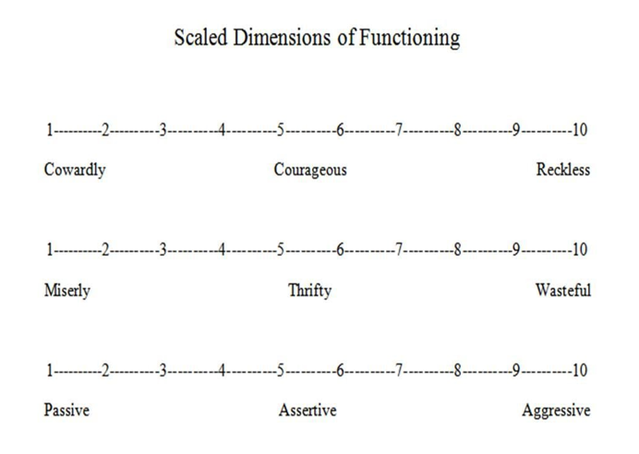
Source: Shapiro, 2015a, p.80. John Wiley and Sons, with permission.
Every bit you can see from these examples, when styles of functioning are conceptualized on continuums, both sides involve advantages, both involve disadvantages, and optimally adaptive combinations are located in the center—the Goldilocks Zone (Shapiro, 2020). For instance, passive beliefs has the advantage of respecting other people's rights and the disadvantage of neglecting our own, aggressive behavior has the exact opposite prepare of attributes, and assertiveness involves a balanced respect for both other people and the self.
Many mental health problems tin can be conceptualized every bit points close to the poles of spectrums like these, and optimally effective styles are usually in the mid ranges. Aristotle was a good psychologist.
Ten-point scales take important capabilities every bit conceptual tools. Their two-sided structure prompts us to consider the elements of truth and value on both ends of the spectrum and to see how they can be brought together in optimal combinations. Used in this way, x-point scales are visual templates for dialectical thinking; they guide a thought process that moves from opposing polarities to counterbalanced syntheses.
Both the concrete structure of the scales and the numbers used to calibrate them prompt the states to think in careful, measured ways, rather than in big, undifferentiated chunks of meaning. The idea is non to be picky nearly numbers simply to arroyo 2-sided issues as matters of caste and balance.
While this greyness style of thinking is more than labor-intensive and less cathartic than glomming onto one side of a two-sided upshot and lunging for a simple solution, it is far more accurate and constructive. Used finer, scales like these provide an antitoxin for black-and-white thinking.
In blog posts to come, we will use this conceptual tool to a wide diverseness of purposes and content areas, including:
- Self-assessment
- Understanding other people
- Personal goal setting
- Mental wellness problems such as anxiety, assailment, perfectionism, and oppositionality
- Moral dilemmas
- Problems in romantic and marital relationships
- Parent-child problems
- Politics
In the meantime, y'all might effort out this analytical technique on the human issues, dilemmas, and conflicts of interest to yous. I call up you will detect that you tin can conceptualize all sorts of bug by constructing x-point scales with poles respective to 2 opposite extremes and adaptive syntheses in the middle. I will provide many examples of these analyses in posts to come.
Source: https://www.psychologytoday.com/us/blog/thinking-in-black-white-and-gray/202005/finding-goldilocks-solution-black-and-white-thinking
0 Response to "What Is Art Balance Elifent Example Black and White"
Post a Comment